Fit every core level with physics, not guesswork.
xpsflow reads what your XPS instrument writes, fits each region under literature constraints, lets the data decide how many peaks it supports, audits the result, and tells you, in plain language, how far to trust each number.
The browser version runs the full pipeline on your machine with WebAssembly. Files never leave the page. About 25 MB on first visit, then cached.
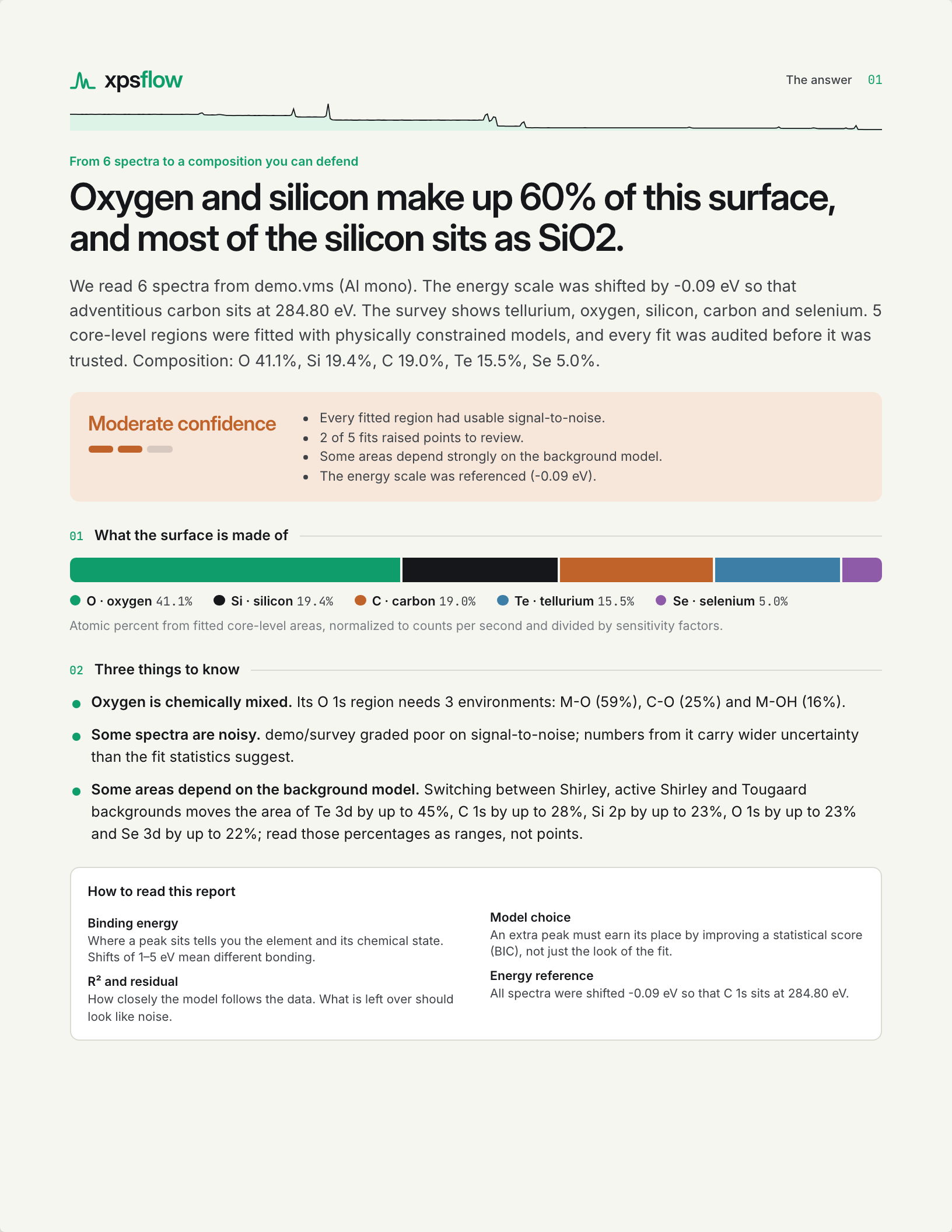
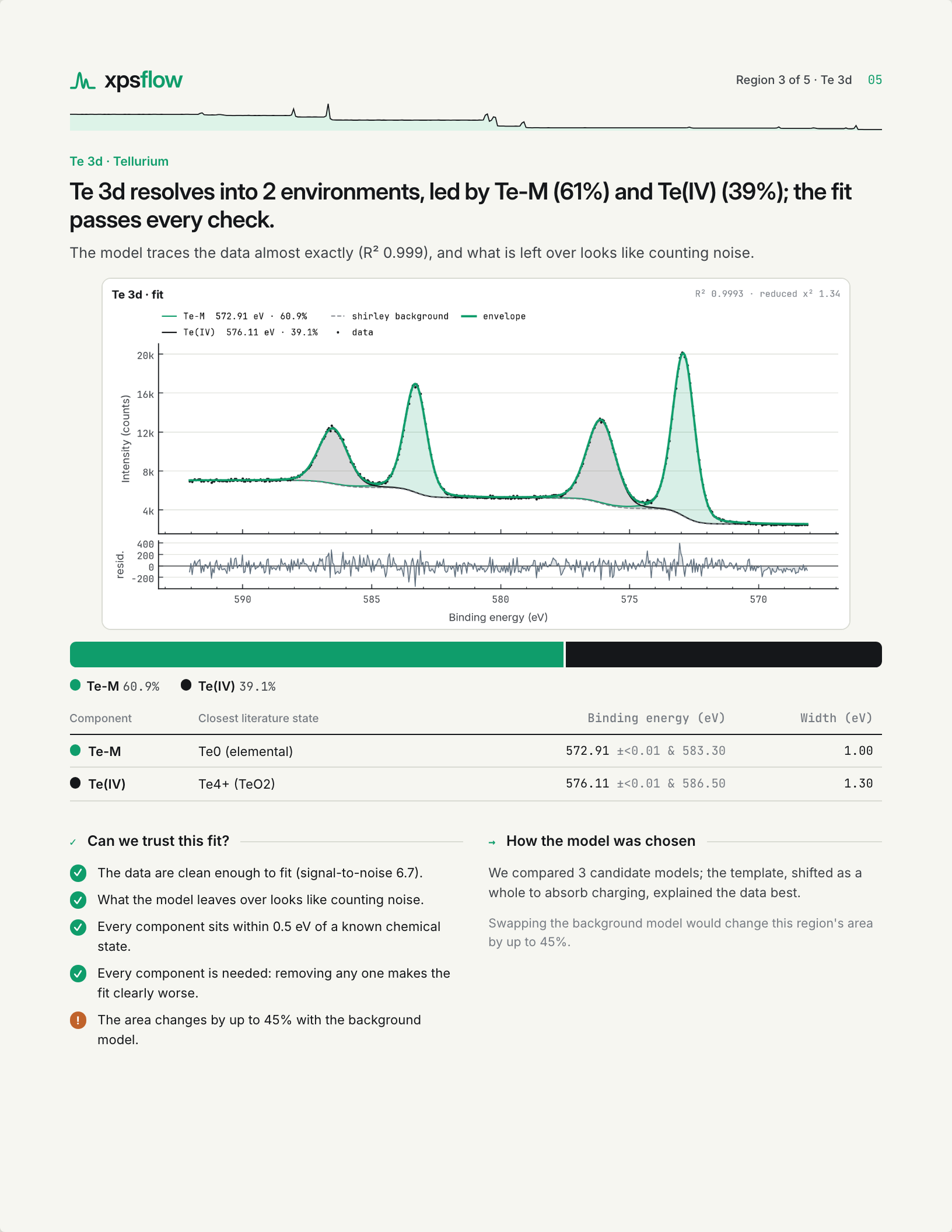
What happens between a raw file and a number you would quote
.kal, ISO 14976 VAMAS, text. Transmission functions travel with the data.Every constraint carries its source
Templates are small YAML files. Each component cites where its position bounds, width bounds and doublet ties come from, and the report prints that table together with an ISO 19830 reporting record. Peaks the software adds itself are marked as such.
How provenance works →Pass energy is not a factor of two
On a Kratos Axis the transmission at pass energy 40 relative to 20 runs from 2.1 to 3.3 across the spectrum. xpsflow uses the function the instrument wrote into the file, falls back to pass-energy scaling only when it must, and says which it did.
The quantification page →On your machine
git clone https://github.com/KarthikSubramanian07/XPS-Flow.git && cd XPS-Flow
uv venv && uv pip install -e ".[web,pdf]"

xpsflow run examples/demo.vms --out runs/demo     # pipeline → report.pdf
xpsflow batch data/ --out runs/batch              # many samples, one comparison
xpsflow serve                                     # the workbench, with the assistant
xpsflow mcp                                       # an MCP server for AI clients
Python 3.11 to 3.13, MIT license. The local install adds PDF reports, the tool-calling assistant and the MCP server.
Documentation
- QuantificationHow areas become a composition, and how far to trust it.
- Constraints and provenanceWhere every bound comes from, and how the reference database is built.
- Fit templatesThe YAML that encodes the physics of a region.
- ArchitectureOne tool layer, three ways in.
- The assistantPointing the tool-calling assistant at a model.
- MCP serverUsing xpsflow from an AI client.
- SecurityThreat model, limits and the stress suite.
- The website and the browser buildHow the static site and the in-browser workbench are built and deployed.